

UMA-Resolved Markets
Prediction markets use the UMA Optimistic Oracle for decentralized, permissionless resolution.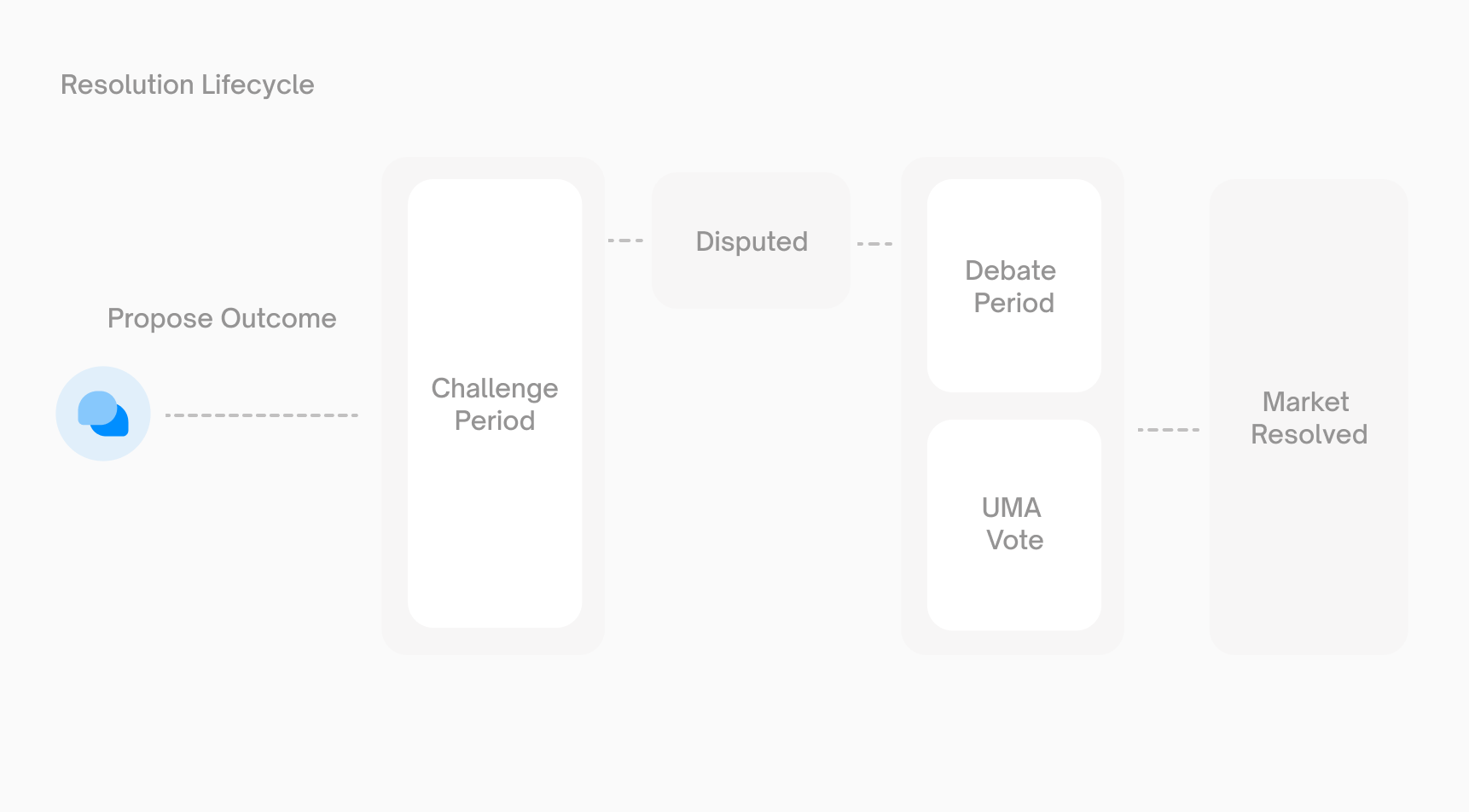
Resolution Rules
Every market has pre-defined resolution rules that specify:- Resolution source — Where the outcome will be determined from (e.g., official announcements, specific websites)
- End date — When the market is eligible for resolution
- Edge cases — How ambiguous situations should be handled
1
Proposal
Anyone can propose a resolution by:
- Selecting the winning outcome
- Posting a bond (typically $750 pUSD)
- Submitting the proposal to the UMA Oracle
2
Challenge Period
After a proposal, there’s a 2-hour challenge period where anyone can dispute the outcome.
- If no dispute: The proposal is accepted and the market resolves
- If disputed: A new proposal round begins. If the second proposal is also disputed, the resolution escalates to UMA’s DVM (Data Verification Mechanism) for a token holder vote.
- No dispute — Propose then Resolve (fastest, ~2 hours)
- One dispute — Propose, Challenge, second Propose, Resolve (second proposal accepted)
- Two disputes — Propose, Challenge, second Propose, second Challenge, Resolve via DVM vote
3
Dispute - If Challenged
To dispute a proposal:
- Post a counter-bond (same amount as proposer, typically $750)
- The dispute triggers a new proposal round, or if already in the second round, a debate period
#evidence-rationale and #voting-discussion).4
UMA Vote
After the debate period, UMA token holders vote on the correct outcome. The voting process takes approximately 48 hours.
Clarifications
In rare cases, unforeseen circumstances require clarification of the rules after trading begins. Polymarket may issue an “Additional context” update that proposers and voters should consider during resolution. Clarifications:- Cannot change the fundamental intent of the question
- Are published onchain via the bulletin board contract
- Should be considered by UMA voters when resolving disputes
Resolution Timeline
Undisputed resolution: ~2 hours after proposal
Disputed resolution: 4-6 days total
See Resolution Contracts for UMA contract addresses.
Chainlink TWAP–Resolved Up-Down Markets
Each market specifies an asset pair, a start time, and a duration. For example, a market may ask whether BTC/USD moves Up or Down during a specific one-hour window. The TWAP at the start sets the price to beat. When the duration ends, the TWAP at that time sets the final price. Both values come from the same Chainlink TWAP stream. A time-weighted average price (TWAP) represents an asset’s average price over a defined lookback window.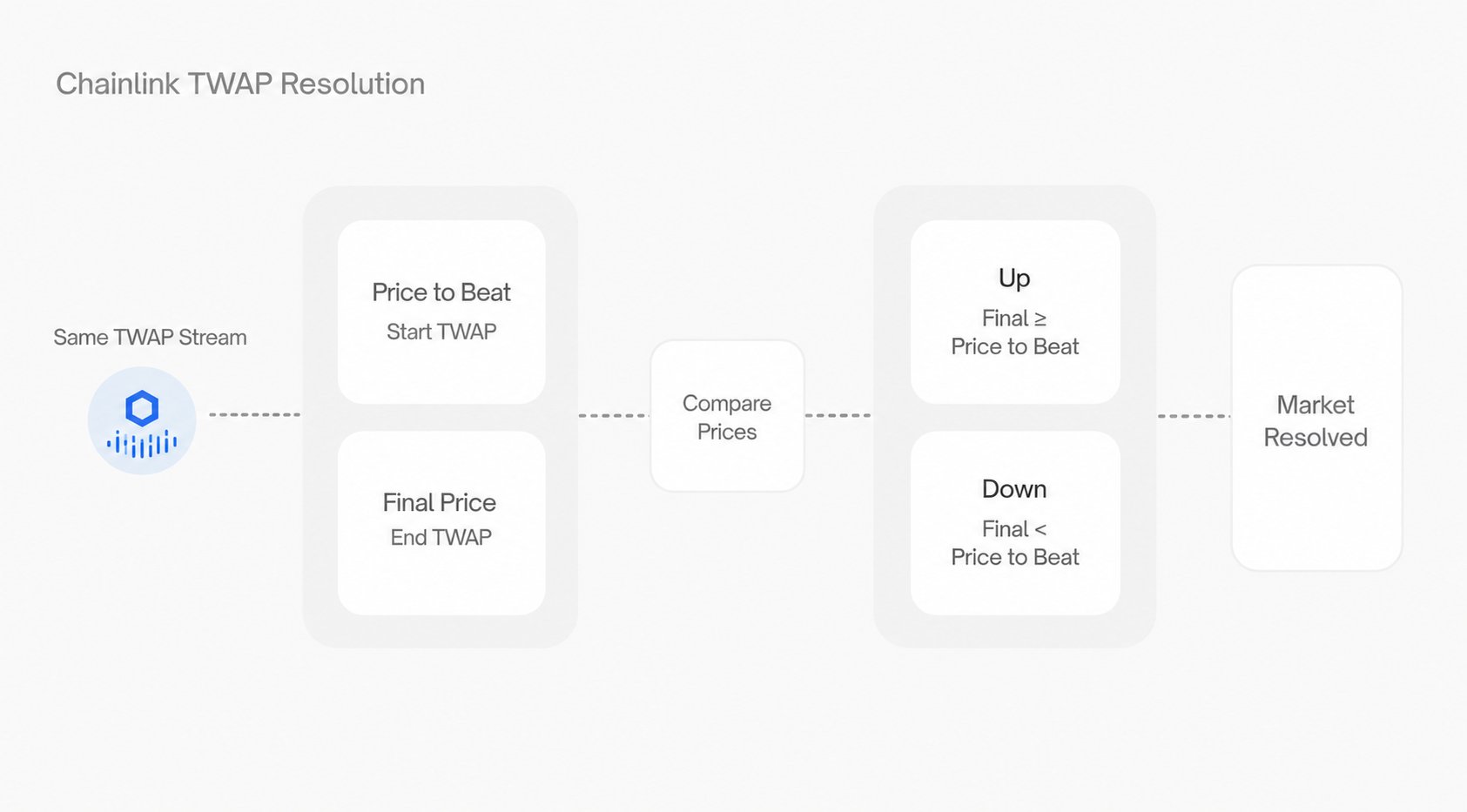
How Resolution Works
The market resolves Up when the final price is equal to or greater than the price to beat, and Down when it is lower. Because the inputs and comparison are fixed, the same observations always produce the same result without UMA’s proposal-and-dispute process.After Resolution
Once a market resolves:- Trading stops — You can no longer buy or sell tokens for this market
- Winning tokens become redeemable for $1.00 each
- Losing tokens become worthless ($0.00)
Resources
- UMA Oracle Portal — View and interact with proposals
- UMA Documentation — Learn more about the Optimistic Oracle
- Chainlink TWAP Prices — Learn how to access Chainlink-computed TWAP prices
- Chainlink TWAP Documentation — Learn how time-weighted average pricing works
- Polymarket Discord — Discuss resolutions and request clarifications